Olive
Olea europaea
Taxonomy
About
Frequently Asked Questions
- The scientific name of Olive is Olea europaea.
- The Olive has a conservation status of Not Evaluated.
- Olive belongs to the kingdom Plantae.
- Olive belongs to the phylum Tracheophyta.
- Olive belongs to the class Magnoliopsida.
- Olive belongs to the order Lamiales.
- Olive belongs to the family Oleaceae.
- Olive belongs to the genus Olea.
What is the scientific name of Olive?
What is the conservation status of Olive?
What kingdom does Olive belong to?
What phylum does Olive belong to?
What class does Olive belong to?
What order does Olive belong to?
What family does Olive belong to?
What genus does Olive belong to?
In the News
Band of baby sea turtles swim into ocean after historic California nesting
Hatchlings emerge after discovery in September of first sea turtle nests ever to have been recorded on US west coast Two months after the discovery of the first sea turtle nests ever to have been recorded on the US west coast, the eggs have hatched – and California’s first group of 75 native-born olive ridley sea turtles have been released into the Pacific. The eggs incubated at the Aquarium of the Pacific in Long Beach after the historic discovery of two separate nests in September at southern California beaches, a shift likely driven by this year’s El Niño conditions. Continue reading...
The Guardian Environment · 11/16/2026
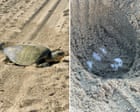
In historic first, tropical turtles spotted nesting on California beaches
What caused the turtles to begin nesting farther north than usual is the ‘million dollar question’ A sea turtle crawled out of the surf in southern California last weekend around sunset and started laying eggs in the sand. People on Huntington Beach who saw the female olive ridley sea turtle were shocked and excited. And they weren’t the only ones freaking out, said Justin Viezbicke, the California stranding coordinator for the National Oceanic and Atmospheric Association (Noaa). Continue reading...
The Guardian Environment · 9/24/2026

Agency says sea turtle eggs laid on California beaches are a first for the US West Coast
HUNTINGTON BEACH, Calif. (AP) — A reptile believed to be struggling in sand at a Southern California beach was simply making history: a sea turtle laying eggs on the U.S. West Coast. And three days later, there were more. An olive ridley turtle — maybe the same one — laid eggs on Sept. 19, a […]
Mongabay · 9/23/2026
So Many Birds, So Little Time (or Bands)
The morning began just before sunrise with competing Great Horned Owls calling back and forth across Oliver Reservoir in the far southwest of the Nebraska panhandle. It was the first chilly fall-like...
Audubon · 9/23/2026

How the first published Indigenous ethnobotanist & elders recorded their people’s medicinal knowledge
CARAMURU/PARAGUASSU INDIGENOUS TERRITORY, Brazil — Looking at the landscape of dry and cleared mountains around her house, Marta Xavier de Oliveira remembered when it was a forest. “When we got sick, that’s where we got our medicine from,” Oliveira, known as Dona Marta, 87, told Mongabay. An Indigenous elder of the Kariri-Sapuyá people, she stands […]
Mongabay · 8/13/2026

On a Philippine beach, villagers are stepping up to save sea turtle nests
Beaches in San Vicente municipality in the Philippines’ Palawan province are crucial nesting grounds for olive ridley sea turtles. But the turtles and their babies face perilous journeys on those beaches — from dogs, tourism, and increasingly severe storms and high tides. To counter these threats, the NGO Large Marine Vertebrates Research Institute Philippines (LAMAVE) […]
Mongabay · 8/6/2026