Ensis
Ensis
Taxonomy
About
Frequently Asked Questions
- The scientific name of Ensis is Ensis.
- Ensis belongs to the kingdom Animalia.
- Ensis belongs to the phylum Mollusca.
- Ensis belongs to the class Bivalvia.
- Ensis belongs to the order Adapedonta.
- Ensis belongs to the family Pharidae.
What is the scientific name of Ensis?
What kingdom does Ensis belong to?
What phylum does Ensis belong to?
What class does Ensis belong to?
What order does Ensis belong to?
What family does Ensis belong to?
In the News
This 23-foot crocodylian may have ruled South America’s food chain
Miocene South America was packed with giant prey—and the predators hunting them were just as spectacular. Fossil bite marks suggest crocodylians, especially the enormous Purussaurus neivensis, were more important predators than mammals in this ancient tropical ecosystem. At around seven meters long, Purussaurus may even have helped control populations of giant herbivores.
ScienceDaily Plants & Animals · 8/19/2026

A shy bird found only in Nepal is waiting for the world to notice
Nepal’s shrubby hillsides are home to a medium-sized bird with brownish upperparts, distinctive black streaks from the shafts of its feathers and, sometimes, a chalky white facial patch. It’s the spiny babbler (Turdoides nipalensis), a mysterious bird, recorded only in Nepal. In June, the bird made headlines with a sighting for the first time in the […]
Mongabay · 8/4/2026
New giant salamander species discovered in 3.5-million-year-old fossils
Fossils discovered in Japan more than two decades ago have finally been identified as a new genus and species of giant salamander. Limnospondylus ajimuensis lived around 3.5 million years ago in a warmer, wetter Kyushu and may have reached 1.1 meters in length. Its discovery hints that many more unknown giant salamanders could be hiding among fossils previously given the wrong classification.
ScienceDaily Plants & Animals · 7/24/2026
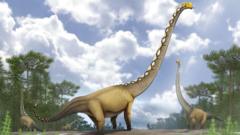
New dinosaur species as long as cricket pitch discovered in Thailand
The plant-eating dinosaur, named Uragasaurus kalasinensis, is thought to have lived about 150 million years ago.
BBC Science & Environment · 7/11/2026
This four-winged dinosaur may have terrorized Earth's earliest birds
A newly discovered feathered dinosaur called Jian changmaensis may be the missing predator responsible for mysterious piles of crushed prehistoric bird bones in China. The four-winged glider, a close cousin of Velociraptor, helps reveal how early birds and their dinosaur relatives shared the same ancient landscape.
ScienceDaily Plants & Animals · 6/23/2026
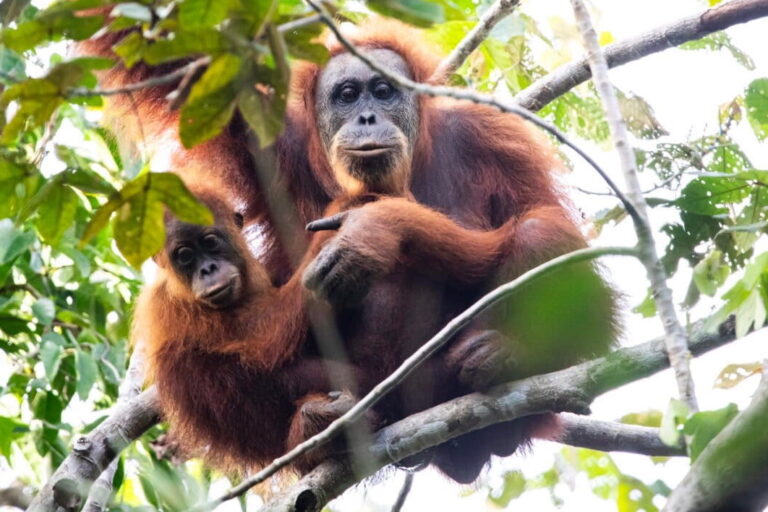
Climate-fueled landslides killed an estimated 58 Tapanuli orangutans, study finds
JAKARTA — Climate change has become a direct threat to the survival of the world’s rarest great ape, according to scientists, after landslides triggered by an unusually intense storm killed an estimated 58 critically endangered Tapanuli orangutans (Pongo tapanuliensis) in Indonesia’s Batang Toru ecosystem. The estimate comes from a new study published in Current Biology, […]
Mongabay · 6/16/2026